
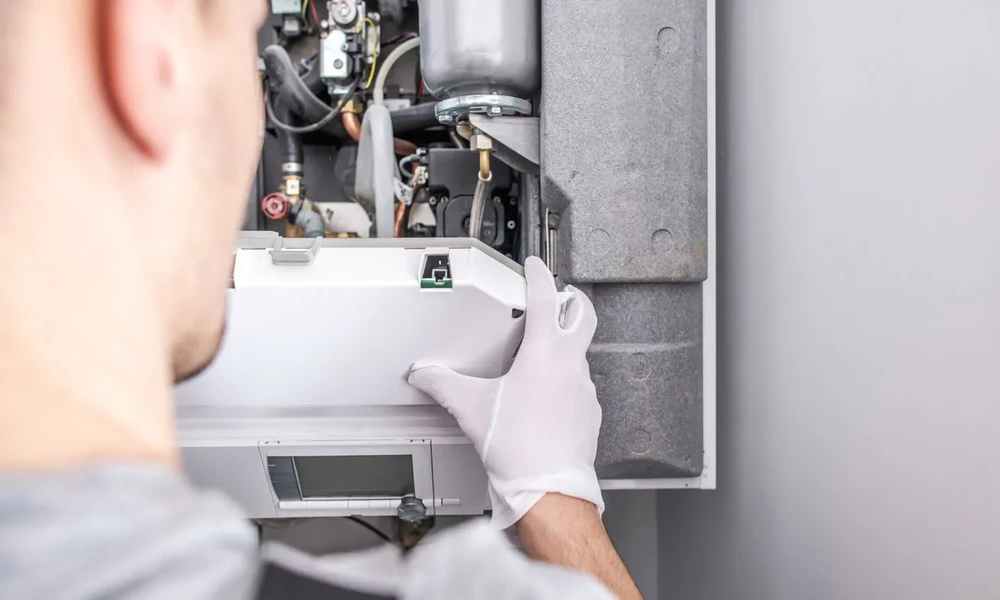
Every furnace failure I have ever heard about happened at 2 a.m. on the coldest night of January. Never on a mild Tuesday afternoon in October when the truck could roll up at leisure. That is not bad luck. Cold weather does not create furnace problems so much as it reveals ones that were already sitting there, quietly, through a mild fall you never noticed.
Here is the short answer: your furnace stops because something in the system hits a limit it cannot pass. A safety switch trips, a sensor reads wrong, a flame loses its air, or the unit simply cannot move heat out of itself fast enough. Your job tonight is to figure out which category you are in, and whether you can fix it with a filter and a flashlight or you need someone at the door.
Below you will find the three triggers that show up most often, a diagnostic framework you can run in about twenty minutes, and a clear line between what a homeowner should touch and what belongs to a technician.
Why does cold weather break a furnace that worked fine last month?
A furnace in October runs short cycles. The house holds heat, the burner kicks on for a few minutes, and everything shuts down long before any internal temperature climbs. In a hard cold snap, that same unit runs for thirty, forty, fifty minutes without a break. Different machine entirely.
Long runtimes expose three things at once: airflow restriction, ignition weakness, and heat rejection limits. A filter that was 70 percent clogged in November becomes a wall by January. A flame sensor with a thin oxide film gets lazy when the burner runs hot for an hour. And a furnace that cannot shed heat fast enough will trip its high limit switch to protect itself.
All three problems are thermostat-independent. Which is why homeowners stare at a smart thermostat, see a call for heat, and conclude the thermostat is broken. It almost never is.
The four-part check you can run tonight
I call this the Air, Flame, Drain, Draft sweep, and it exists because most homeowner-level furnace calls fall into exactly those four buckets. It is not a diagnostic tool for a gas valve or a control board. It is a way to find the obvious stuff fast and stop guessing.
- Air. Turn the system off at the thermostat. Pull the filter and hold it up to a light. If you cannot see light through it, that is your answer for tonight. Replace it. Never run the furnace without one installed, since the blower will pull dust straight into the coil.
- Flame. Watch through the sight glass for one full cycle. You want a steady blue flame that pulls toward the burner. A yellow, floating, or flickering flame means a combustion air or gas pressure issue. Do not keep resetting it. Shut it down and call.
- Drain. A high-efficiency condensing furnace makes water and sends it to a floor drain or condensate pump through a small trap. In freezing weather, that line or the pump reservoir can ice up. If the trap is blocked, the unit shuts itself off as a safety measure.
- Draft. Check the vent pipe termination outside for snow, ice, or a bird nest packed into the intake. A blocked concentric vent on a cold, windy night is one of the most common and most preventable no-heat calls there is.
Two of these four fixes cost nothing. Two of them are things you should not touch. That split is the whole point of the sweep.
What the high limit switch is actually telling you
Most people have never heard of this part until it strands them in a cold house. The high limit is a safety thermostat mounted near the heat exchanger. When internal air gets hotter than it should, the switch opens and cuts the burner. Some furnaces lock out for a few minutes. Some lock out until you cycle power.
Homeowners read that as a furnace that “keeps shutting off.” Technicians read it as a heat-moving problem, and nine times out of ten the root cause is air: a clogged filter, a closed supply register in a guest room, a return grille buried behind a couch, or a blower wheel caked in dust. According to efficiency guidance from the Department of Energy, restricted airflow is one of the leading causes of heating system inefficiency and premature equipment wear, so this is not a fringe theory.
Here is the part I would push back on. People replace the limit switch. They should not. That switch is doing its job perfectly. It is the messenger, and swapping it just mutes the alarm while the real problem keeps cooking the heat exchanger.
Ignition problems and the part nobody cleans
Modern furnaces use either a hot surface igniter or a spark ignition system. Both rely on a flame sensor, a small metal rod sitting in the burner flame that proves to the control board that ignition actually happened. It works by sensing a tiny current through the flame itself. That principle, that flame conducts electricity in a measurable way, has been understood since the nineteenth century and is documented in engineering references maintained by NIST.
Over a season, the rod collects a thin layer of oxide and combustion residue. It still glows. It still sits in the flame. It just stops conducting cleanly. The board sees no flame, shuts the gas valve, waits, retries, and eventually locks out. That retry cycle is the click-click-click pattern so many people describe over the phone.
Cleaning a flame sensor with fine steel wool is genuinely a five-minute job. I would still tell a first-timer to watch a technician do it once before reaching into a burner compartment with the power on. Gas appliances reward patience and punish confidence.
A note on sizing, because it explains a lot of mid-winter disappointment
If your furnace ran fine for years and suddenly cannot hold temperature on the coldest nights, your equipment might be correctly sized for a typical winter day and simply short at design temperature. Contractors size heating equipment against a design temperature for the local climate, and the trade body that publishes those sizing standards is the Air Conditioning Contractors of America. A system sized for an average cold week will struggle in an outlier cold snap, and no amount of filter changing fixes that.
That is not a defect. It is a design tradeoff. Buttoning up attic insulation and sealing the biggest air leaks usually does more for those nights than a bigger furnace would.
When to stop and call
Draw the line at the gas valve. If you smell gas, leave the house and call your utility from outside. Beyond that, call for a technician when you see any of these:
- The furnace locks out three times in a row after resetting
- You smell gas, exhaust, or something acrid near the unit
- The flame is yellow or lifting off the burner
- The blower runs but the air coming out of the registers is cold
- You hear a scraping or grinding sound, which points to the blower motor
- Any carbon monoxide alarm in the home has sounded
If you are in western Massachusetts and the outdoor temperature is dropping fast, a furnace that has locked out twice is not a wait-until-morning problem. Homeowners across the region rely on emergency furnace repair in Hampden County services specifically because these failures cluster on the coldest nights, and getting a technician on the schedule at 8 a.m. beats joining the queue at midnight.
What to do before anyone arrives
Shut the thermostat off. Clear a path to the furnace, about three feet on all sides, since a technician will need to pull panels and read data plates. Write down the model and serial number, the exact symptoms, and the first time you noticed them. Text yourself a photo of the error code light pattern if your control board has one.
That information compresses a diagnostic visit dramatically. A tech who already knows it is a lockout after long runtime arrives with the right parts instead of making a second trip.
Tonight, run the Air, Flame, Drain, Draft sweep. Tomorrow, call someone who knows what the limit switch is telling you. And next fall, change the filter in September, before the first cold snap has a chance to expose what you have been ignoring.